
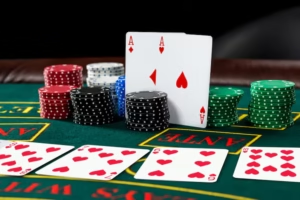
Position and Information in Poker Games – Position and information are two of the most important concepts in poker games, especially in casino and competitive formats. While poker is often seen as a game of cards, experienced players understand that success depends heavily on when you act at the table and how well you interpret available information. These elements help explain why poker is considered a strategic game rather than one based purely on chance.
Position in poker refers to a player’s seating order relative to the dealer button and determines when a player must act during each betting round. In most poker variants, such as Texas Hold’em or Omaha, the dealer button moves clockwise after each hand, changing player positions. Players who act later in a betting round are said to be “in position,” while those who act earlier are “out of position.”
Being in a late position is generally advantageous because it allows a player to see how others act before making a decision. For example, a player acting last can observe whether opponents check, bet, or raise, providing valuable clues about the strength of their hands. Early-position players must act with limited information, often making decisions without knowing how the rest of the table will respond. As a result, early positions usually require more cautious play.
Position affects nearly every aspect of poker decision-making. It influences which starting hands are played, how aggressively players bet, and how often they bluff. Late-position players can apply pressure more effectively, control the size of the pot, and make more informed choices. This positional advantage is one reason why experienced players place great importance on seating dynamics and table awareness.
Information in poker refers to all observable data that helps players make decisions. This includes betting patterns, bet sizes, timing, and player behavior. In live poker games, information may also come from physical cues such as posture or facial expressions, although these are subtle and not always reliable. In online poker, information is limited to betting actions, timing, and game history.
Poker is a game of incomplete information because players cannot see opponents’ cards. Instead, they must infer hand strength based on how others act. For example, a large raise may indicate confidence, while repeated checking could suggest weakness. Over time, players build profiles of opponents’ tendencies, learning who plays aggressively, who bluffs frequently, and who plays conservatively.
The interaction between position and information is crucial. Acting later allows players to gather more information before making decisions, while early action limits available data. This is why position enhances the effective use of information. A player in late position can respond more accurately to betting signals, while an early-position player must rely more on probabilities and caution.
In casino poker, understanding position and information also promotes structured and fair gameplay. Dealers enforce consistent action order, and rules ensure that all players have equal access to visible information. This creates a balanced environment where decision-making is based on observation and analysis rather than hidden advantages.